The 1862 Issue Proofs
In 1861 Mr. William Houghton, representing the colony of Antigua, inquired of Perkins, Bacon & Co. regarding the preparation of plates for one penny and six pence stamps for Antigua. No order was placed until 1862. On March 15, 1862 the firm prepared a drawing which is now in the Royal Collection. No additional essays for the design have been reported.
On May 10, 1862 Perkins, Bacon & Co. completed the first Antigua stamp die. The engraving was performed by Charles Henry Jeens from a watercolor by Edward Corbould. The head portion of the design is similar to that used by the Company in producing the stamps of St. Lucia in 1860 and of St. Vincent in 1861.
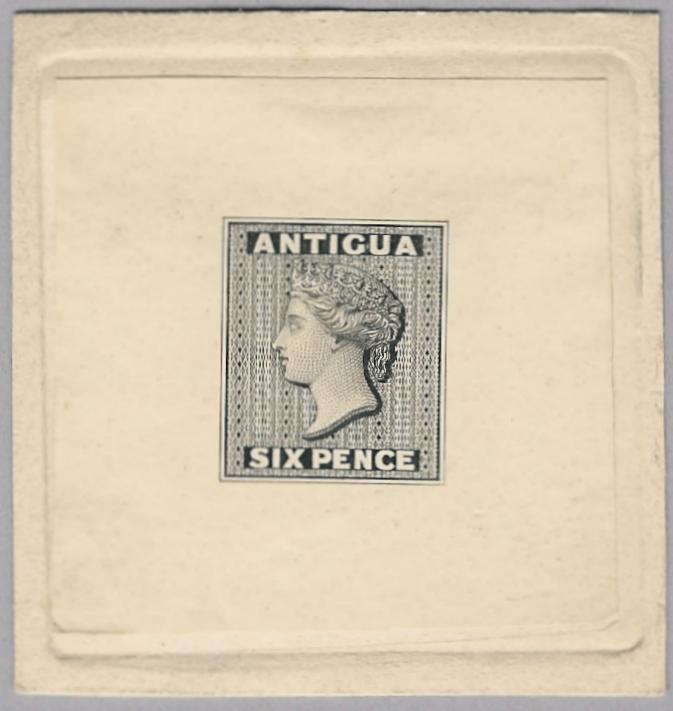
Large Die Proof
Die proof, in black, of completed master die on 48mm square piece of india paper die sunk onto larger card (55mm by 59mm).
Robson Lowe (see references) lists a die proof printed directly on card. This listing may be in error as the editor's collection included an example listed as printed on card that was actually a cut down version of india paper mounted on card.
Plate Proof In Black
A plate of 120 subjects was prepared using the master die. The plate consisted of ten horizontal rows of twelve stamps each. The plate was laid out with only minor variation in the width of the gutters between stamps.
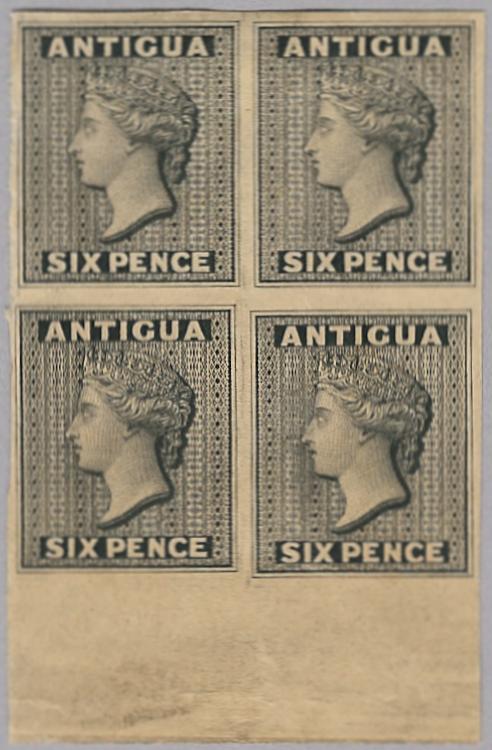
Bottom sheet margin plate proof block of four in black on stout, unwatermarked, grayish paper.
The above block is from positions 103-104, 115-116 on the sheet and can be plated because the bottom right stamp bears a dot in the letter "N" of "PENCE" which is known from that position. The various plate flaws that are found on the issued stamps can also be found on the plate proofs (see 1862 issue varieties).
Trial Color Plate Proofs
According to the record books of Perkins, Bacon & Co., on June 4, 1862 the firm submitted trial color proof impressions in two shades of green of the six pence stamps to William Houghton for his approval. They recommended that the darker shade be selected. In Mr. Houghton's reply of June 6, 1862 he agreed to the choice of the darker shade.
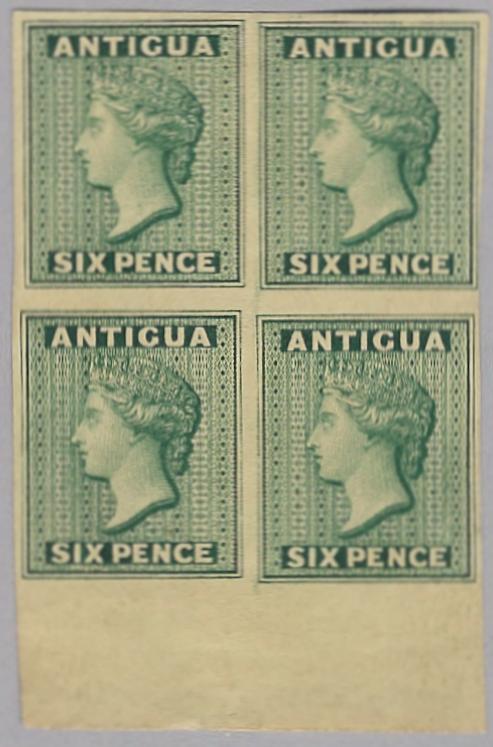
Deep green trial color plate proof block of four on stout, unwatermarked, grayish paper.
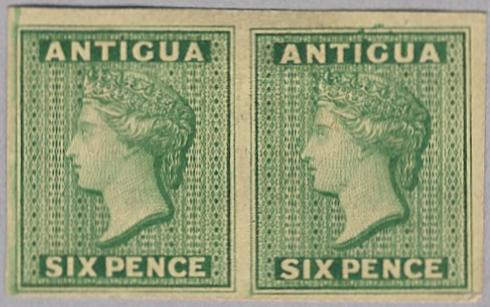
Yellow green trial color plate proof pair on stout, unwatermarked, grayish paper
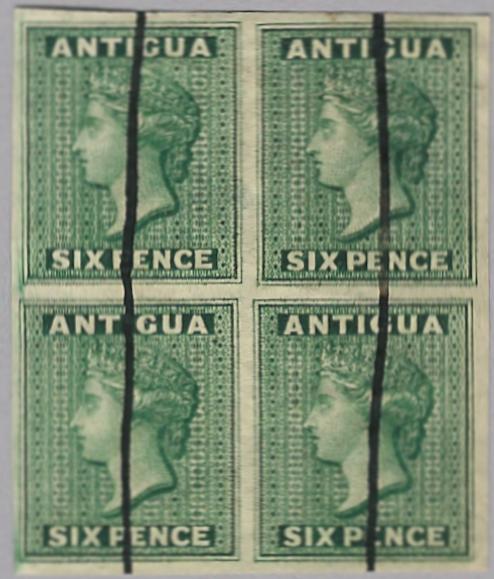
Deep green trial color plate proof block of four on somewhat thinner, crisper, unwatermarked, paper with vertical pen stroke cancellation. These pen cancelled stamps are believed to have been used by Perkins, Bacon & Co. as samples. Many examples have had the pen cancel subsequently removed by the use of chemicals.
Proofs From The Defaced Die
In 1891, after the uniform Leeward Island stamps were introduced, remaining supplies of Antigua stamps and postal cards were sold to a stamp dealer. Apparently included in the sale was the original printing plate that had been defaced by gouging. At least two sheets of impressions in black were pulled from the defaced plate. One sheet remained intact as of 1990. The original plate used to produce the six pence stamps is in the Leinster collection at the Science and Art Museum in Dublin, Ireland.
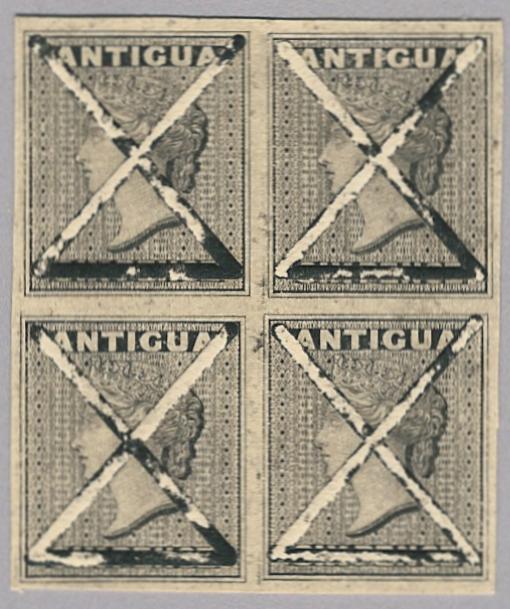
Black proof block from defaced plate printed on card. The pressure of the printing process has caused the paper to emboss heavily in the areas of the plate gouge.
Sample Sheet
Perkins, Bacon & Co. produced the sample sheet shown below sometime around 1880. The sheet includes head vignettes as used for the stamps of Antigua (top left), St. Helena (top right), South Australia (bottom left) and St. Lucia (bottom right) as well as engine turned backgrounds. This was likely produced in conjunction with a bid for a stamp contract. Fewer than five examples have been reported.
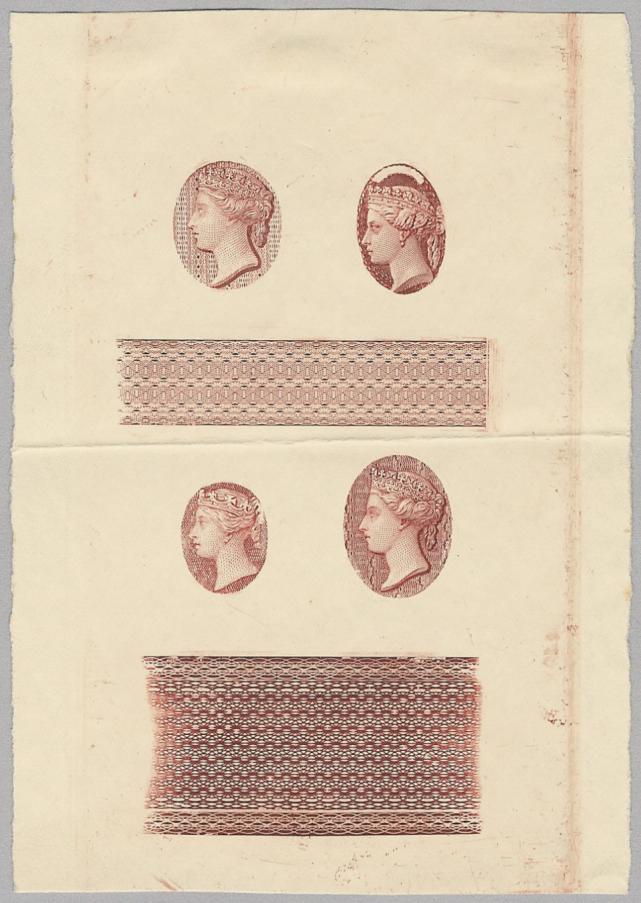
Proof in red-brown on stout white paper showing die sinking lines at sides. Size is 80mm by 113mm overall.
Head Only Impressions
Later proof impressions of the Antigua head only vignette were made between 1902 and 1935. They exist in a variety of colors including gray, blue-green, rose, vermilion, orange, violet and gray-blue. See Robson Lowe (see references)